Brunswick Town's stucco and the five-year repaint
Brunswick Town, laid out in the mid-1820s by Charles Busby, was one of the first two conservation areas Hove designated, in 1969. Its square and terraces are defined by stuccoed façades with columns, pilasters and bow fronts, under slate roofs and long parapets. The fronts are protected by law as well as by planning: the Hove Borough Council Act 1976 requires the fronts of 1 to 58 Brunswick Square, 1 to 42 Brunswick Terrace and 1 to 8 Brunswick Place to be kept unaltered and repainted every five years in the specified Brunswick Cream, with 2026 the latest round. The council asks for that work between 1 April and 31 October and stresses thorough preparation. Any cracked or hollow stucco has to be put right before the painters arrive, cut back to sound edges and repaired to match the original surface and profile.
Adelaide Crescent and Palmeira Square
The Grade II* houses of Adelaide Crescent, begun to a design by Decimus Burton in 1830 and finished in the mid-1860s, continue the stucco north into Palmeira Square. Palmeira's original deeds required the fronts and railings to be painted every three years, later in three coats of best oil paint in a pale stone colour, and in the 1970s Hove Council insisted on magnolia. Repairs to listed fronts like these may need listed building consent, and the render used should be compatible with the old stucco rather than a hard modern mix.
The Avenues, Cliftonville and The Drive
North of the seafront, an Article 4 direction made in 1991 covers The Avenues conservation area and parts of Cliftonville and The Drive. Repainting in a new colour, or painting a façade that has never been painted, needs planning consent, and the acceptable smooth matt masonry colours are limited to a short list of pale shades or white, the same on both halves of a semi. Textured paint and stone cladding are not acceptable, but like-for-like repairs need no consent. For render, that means matching the existing texture and finish exactly.
Weather on the Kingsway
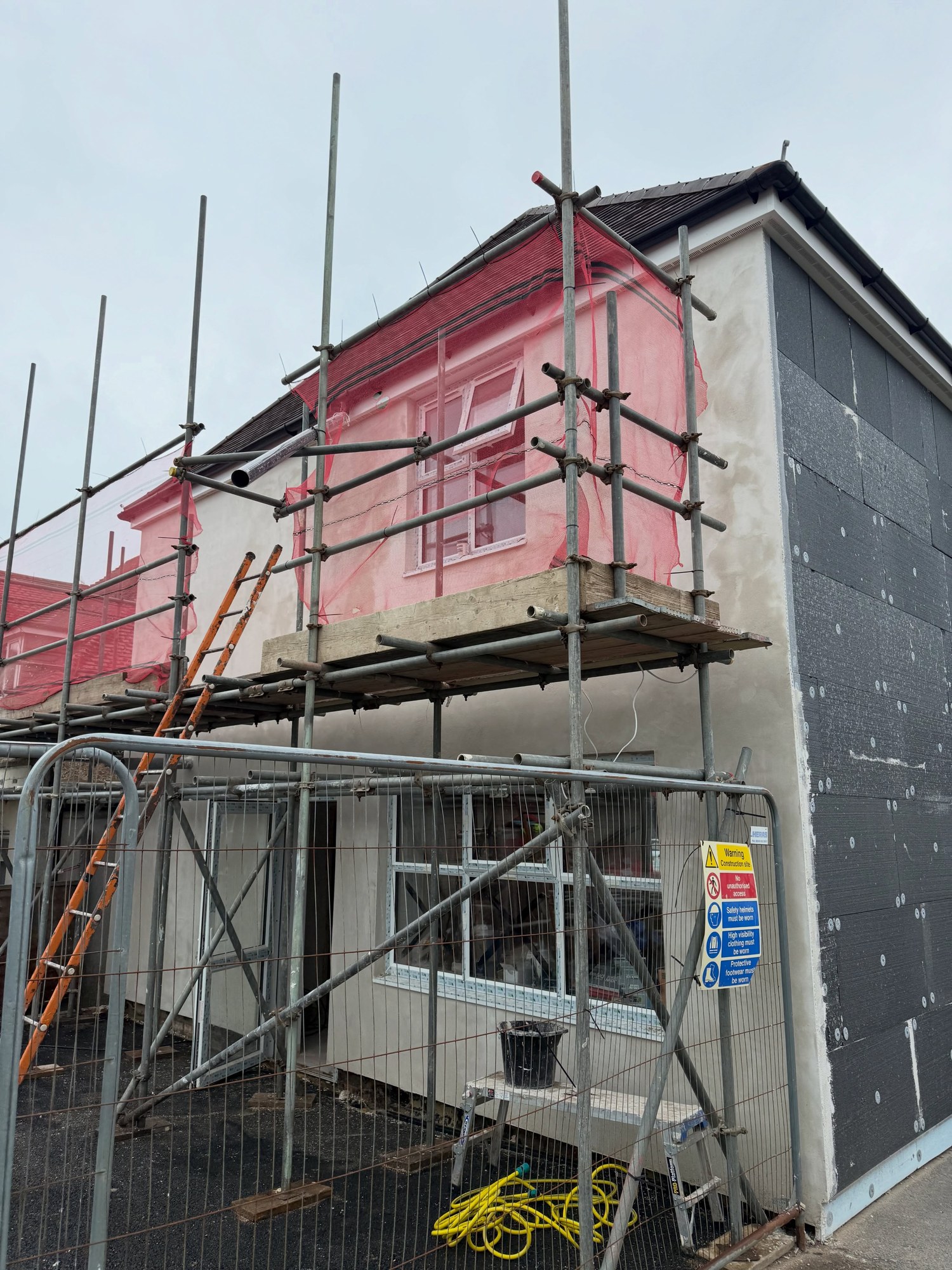
Hove's beach is a storm beach, all shingle at high tide, and the houses and blocks facing it along Kingsway take spray and wind-driven rain head on. Render on those elevations tends to fail first at cills, parapets and the base of the wall, so check those spots each spring. Fresh render needs shelter from rain, frost and drying winds while it cures, so seafront work is planned for settled weather with screening on the scaffold. Further west, the eleven Seaside Villas built on the beach between Hove Lagoon and Portslade in the 1910s show how close to the water some Hove homes stand.
Twentieth-century houses
In Hangleton, Mile Oak and Portslade, render is more often sand and cement or pebble dash, which can be repaired, renewed or overcoated with a through-coloured system; see silicone rendering in Hove. If damp is coming through a rendered wall, our page on damp proofing in Hove explains how we trace it. Pro Finish Plastering covers the whole of Hove, and our main rendering page lists every system we apply. Call 07824 165672 for free advice.