Insulating from the outside
A lot of the heat in a house escapes through its walls, and solid walls in particular lose heat quickly because there is no cavity to fill. External wall insulation tackles that from the outside: insulation boards are fixed to the outer face of the walls and finished with a render system, so the whole house is wrapped in an insulating layer without losing any space inside.
Pro Finish Plastering installs external wall insulation and cork render for homes and commercial buildings across Worthing, Littlehampton and the rest of West Sussex. Because rendering is our trade, the insulation and the finish are carried out by the same team.
How an external wall insulation system goes on
- Survey and prepare. The walls are checked, and anything in the way, such as downpipes, lights and satellite dishes, is noted so it can be taken off and refitted. Loose render or masonry is dealt with.
- Starter track. A base track is fixed level along the bottom of the wall to support the first row of boards.
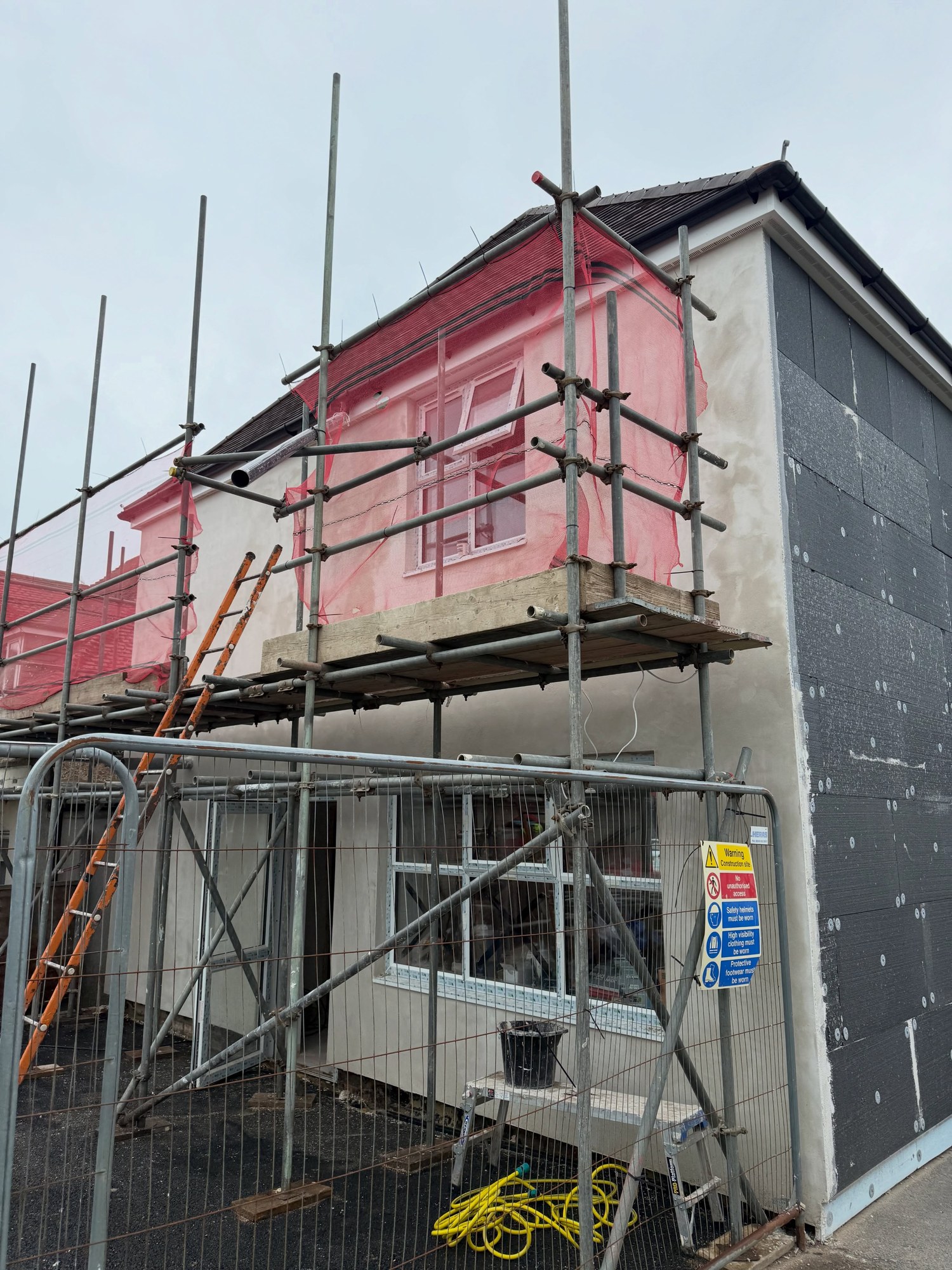
- Boards. Insulation boards are bonded to the wall and secured with mechanical fixings, with joints staggered and tight. We install EPS systems among other forms of insulation.
- Basecoat and mesh. A basecoat is applied over the boards with reinforcing mesh bedded in, and beads are fitted to corners and openings.
- Finish. A render top coat, often a through-coloured silicone finish, protects the system and gives the house its new look.
The photo on this page shows insulation boards being fixed to a building on one of our jobs, ready for the basecoat.
Cork render
Cork render is a render made with cork granules, applied as a thicker coat than an ordinary render. Cork is naturally insulating and breathable, so a cork render adds some insulation and lets moisture move out of the wall rather than trapping it. That makes it a good fit for older solid walls, and for walls where a full board system would be too thick around windows, doors and eaves. It is finished to a smooth or textured surface.
Things to check before you start
- Planning and building regulations. Insulating and re-rendering external walls can need Building Regulations approval, and in a conservation area or on a listed building it may need planning consent. Check with your local council before work starts.
- Details. Window sills, eaves, gas meters, vents and pipes all have to be dealt with properly, because the wall gets thicker.
- Damp. Any existing damp problem needs its cause found and fixed first. See our damp proofing and mould prevention page.
Inside or outside?
Walls can also be insulated from the inside, with insulated plasterboard, which suits single rooms and homes where the outside appearance has to stay the same. Insulating from the outside avoids disturbing the rooms and also reduces cold spots where floors and internal walls meet the outside wall. Our plasterboarding and dry lining page covers insulating from the inside, and our silicone rendering page covers the finish most often used over external insulation.
To talk through insulating your walls, call 07824 165672 or send us a message with a few photos of the house. Quotes and advice are free and without obligation.