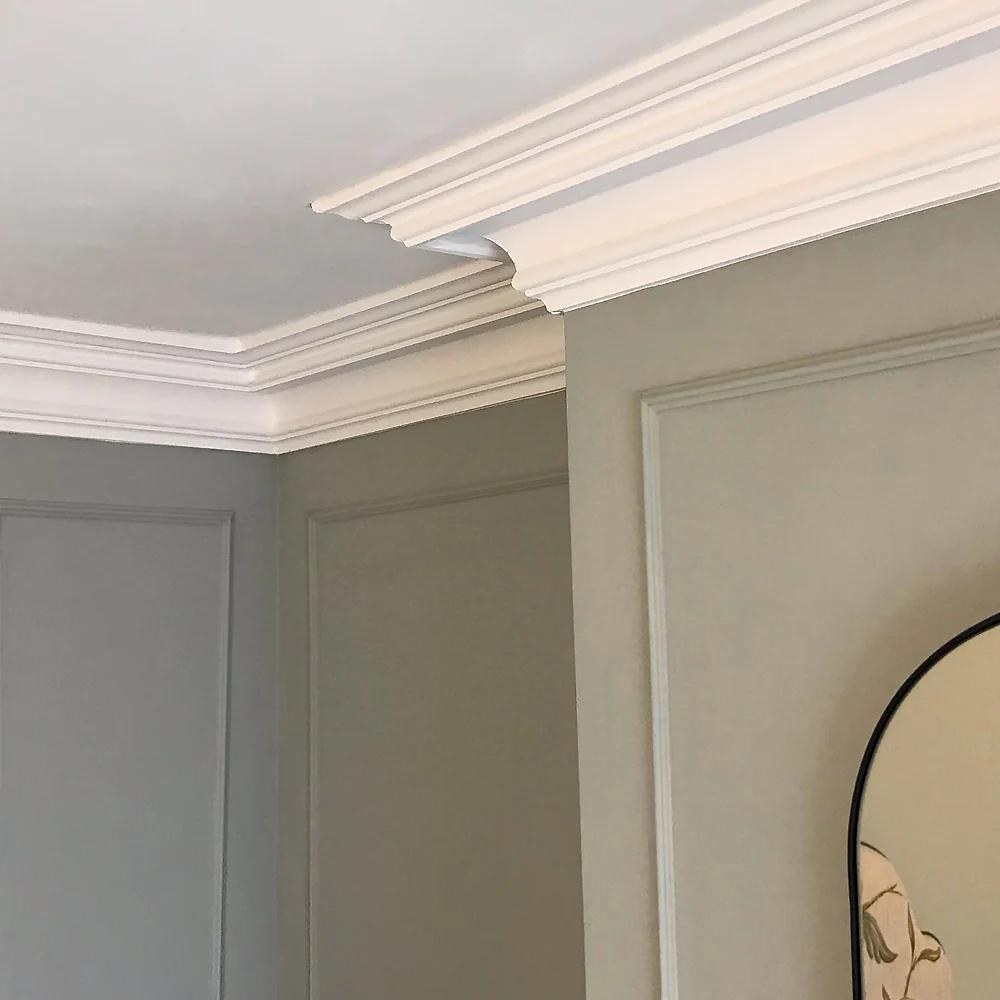
A long tradition of decorated ceilings
Hove's oldest secular building, Hangleton Manor, was built around 1540 for Richard Bellingham, twice High Sheriff of Sussex, and his coat of arms still decorates a period plaster ceiling inside. Three centuries later the town's grandest houses were being finished just as richly. On Palmeira Square, where building began in the early 1850s, one house is listed Grade II* rather than Grade II precisely because of its opulent, custom-designed interior. Willett-built houses around All Saints Church were admired as solidly built and attractively decorated with mouldings. Plasterwork matters to the character of these buildings, inside and out.
When villas became flats
Through the 20th century many of Hove's large Regency and Victorian houses were divided into flats. New walls were set into rooms designed as single spaces, and where a partition met the ceiling the cornice was often cut, boxed in or left stranded on one side. Restoring a room means choosing a fibrous plaster profile that matches what survives, setting out new runs so joints fall at corners or natural breaks, and returning the cornice neatly where it meets the newer wall. Small rooms carved out of big ones may need a slimmer profile than the original, so the ceiling does not feel crowded.
Matching the period
Hove's streets span a wide range of styles. Brunswick Town and Adelaide Crescent are Regency and early Victorian set pieces. The Avenues were built over about 30 years to 1904 in Queen Anne Revival, Gothic Revival, Italianate and other styles. Pembroke and Princes added large late Victorian and early Edwardian houses, and interwar blocks such as Furze Croft brought the cleaner lines of the 1930s Moderne style. A deep, enriched cornice belongs in the first group; the 1930s flats suit a plain cove or nothing at all. If you are unsure, a photo of the room and the ceiling height is enough for us to suggest a profile.
Listed interiors
Listing covers interiors as well as façades, and much of central Hove is listed or in a conservation area. Before original cornice, a ceiling rose or other decorative plaster is removed or altered in a listed building, check with Brighton & Hove City Council. Keep any loose pieces of old moulding, because they are the best record of the original profile.
Fitting and finishing
Mouldings go up after the walls and ceiling are plastered and dry. Old villa rooms are rarely square and their ceilings seldom level, so each mitre is cut to the actual angle of the corner, and long runs follow the ceiling line with any gap at the wall filled rather than left as a shadow. Once the joints are filled and lightly rubbed down, the cornice can be painted with the ceiling or picked out in a slightly different shade to show its profile. If a textured ceiling has to be dealt with first, our page on plastering over Artex in Hove explains how, and our plastering and skimming service in Hove covers walls that need a fresh finish. Pro Finish Plastering covers every part of Hove, and the full range, from a standard 127mm cove to fire surrounds and columns, is on our main coving, cornice and mouldings page. Call 07824 165672 for a free, no-obligation quote.