Sandstone, clay and a town on a slope
Damp in a Haywards Heath house often has as much to do with where it sits as how it was built. Mid Sussex District Council's historic assessment explains that the whole town lies on the Hastings Beds, a complex succession of sandstones, silty sandstones and mudstones, which are commonly clays. Most of the town is on the silty sandstone of the Upper Tunbridge Wells Sand, but around Harlands Road and Blunts Wood Road, fault lines bring in narrow bands of Wadhurst Clay and other clays. The town sits on a minor east-west ridge, and the council's appraisal of The Heath conservation area describes the ground falling fairly steeply north towards the valley of Scrase Stream, a tributary of the Ouse, where the drift geology is alluvium.
What that means in practice: houses cut into a slope have an uphill wall holding back earth, houses on clay bands sit in ground that holds water, and houses in the lower parts of town near the stream have wetter ground around them. Each produces a different kind of damp.
Older brick houses and their weak points
Most of the town's Victorian and Edwardian houses are solid local brick. Their damp proof courses, where they have one, can be bridged by raised paths, flower beds, patios laid too high or render carried down to the ground. Pointing in soft lime mortar fails over time and lets rain in. Some villas were built with basements; the appraisal mentions one on Oathall Road with a basement and attics. Basements and semi-basements below ground level cannot dry out from the outside, and need waterproofing from within.
Working out the cause first
Before any treatment, Pro Finish identifies which kind of damp is present:
- Rising damp: a tide mark low on the wall, salts on the surface and crumbling plaster at skirting height.
- Penetrating damp: patches at any height that worsen after rain, often from cracked render, failed pointing, leaking gutters or downpipes. On the ridge, exposed elevations take more wind-driven rain. Cracked or failing render can be repaired as part of rendering in Haywards Heath.
- Condensation: black mould on cold surfaces such as window reveals, corners and behind furniture, common in flats and in solid-walled rooms in winter.
Treatment and making good
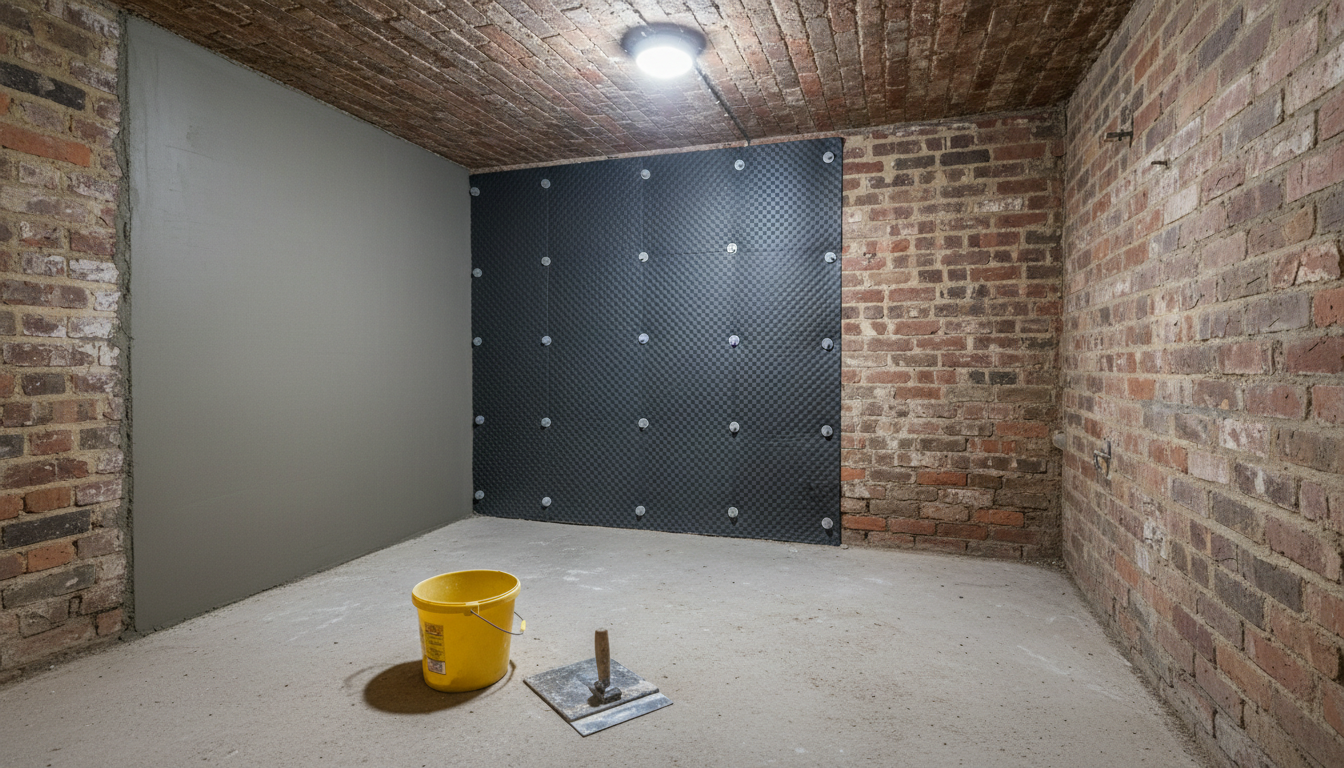
A damp course injection introduces a water-repellent barrier into the mortar at the base of the wall. Below-ground walls and earth-retaining walls are tanked with a waterproof render or coating, or lined with a studded cavity drain membrane that leads water away. Mould is removed and ventilation improved, with insulation or dry lining where a cold wall is the cause.
Afterwards, the plaster almost always needs attention. Salt-contaminated plaster keeps drawing moisture and has to be removed, and the masonry left to dry before it is replastered with materials suitable for a wall that has been damp. That replastering is part of the same job; see float and set plastering in Haywards Heath.
What to note before getting in touch
Record when the damp appears: after rain, in cold weather or all the time. Check ground and path levels against the inside floor, and look at gutters and downpipes after a downpour. If the house is on a slope, tell us which walls are against the hill. Photos of the affected walls, inside and out, help us give useful advice.
There is more on our methods on the damp proofing and mould prevention page, and everything we do in the town is listed on the Haywards Heath page. Free, no-obligation advice on 07824 165672.