Shoreham-by-Sea grew up on flat, low land on the north bank of the River Adur, with alluvium, the silt left by the river, in its old channels and chalk rising to the Downs behind. The Adur is tidal here, and the Environment Agency found its older bank defences too low in places and in poor condition. Its Shoreham Adur Tidal Walls scheme, opened in 2019, added 7.2 kilometres of new defences along both banks and reduced flood risk to more than 2,300 homes and 169 commercial properties. Those walls deal with the river. They do not change what is going on inside an old wall, under a floor or in a steamy bathroom, and that is where most domestic damp starts.
Old walls without a damp course
The town's oldest houses, in the historic core around Church Street, John Street and Middle Street and in Old Shoreham, went up in flint, cobbles and brick laid in soft lime, and most predate any requirement for a physical barrier against ground moisture. On low, river-side land, water can wick up into walls like these, leaving a tide mark, powdery plaster and white salt crystals in the bottom metre or so. Before anyone drills a wall, the usual suspects are checked: a pavement or garden raised above the inside floor, a hard render or plastic paint sealing the base of the wall, or a leaking pipe. Where an injected barrier is genuinely needed, it goes into a mortar joint near the base, the salt-loaded plaster above is hacked off, and the wall is rebuilt in a backing that lets old masonry breathe, as explained under float and set work in Shoreham.
Rain from the sea
Houses on Shoreham Beach take driving rain straight off the Channel, and the October to December period brings the heaviest of it. Rain finds its way through hairline cracks in render, eroded mortar joints, overflowing gutters and gaps around frames, then shows indoors as patches at any height that spread after a stormy night. Indoor treatment alone will not cure that: the outside has to be sorted first, whether that means cutting out and patching render, raking out and refilling joints, or clearing a hopper. If cracked or hollow render is the cause, see rendering in Shoreham.
Walls with earth behind them
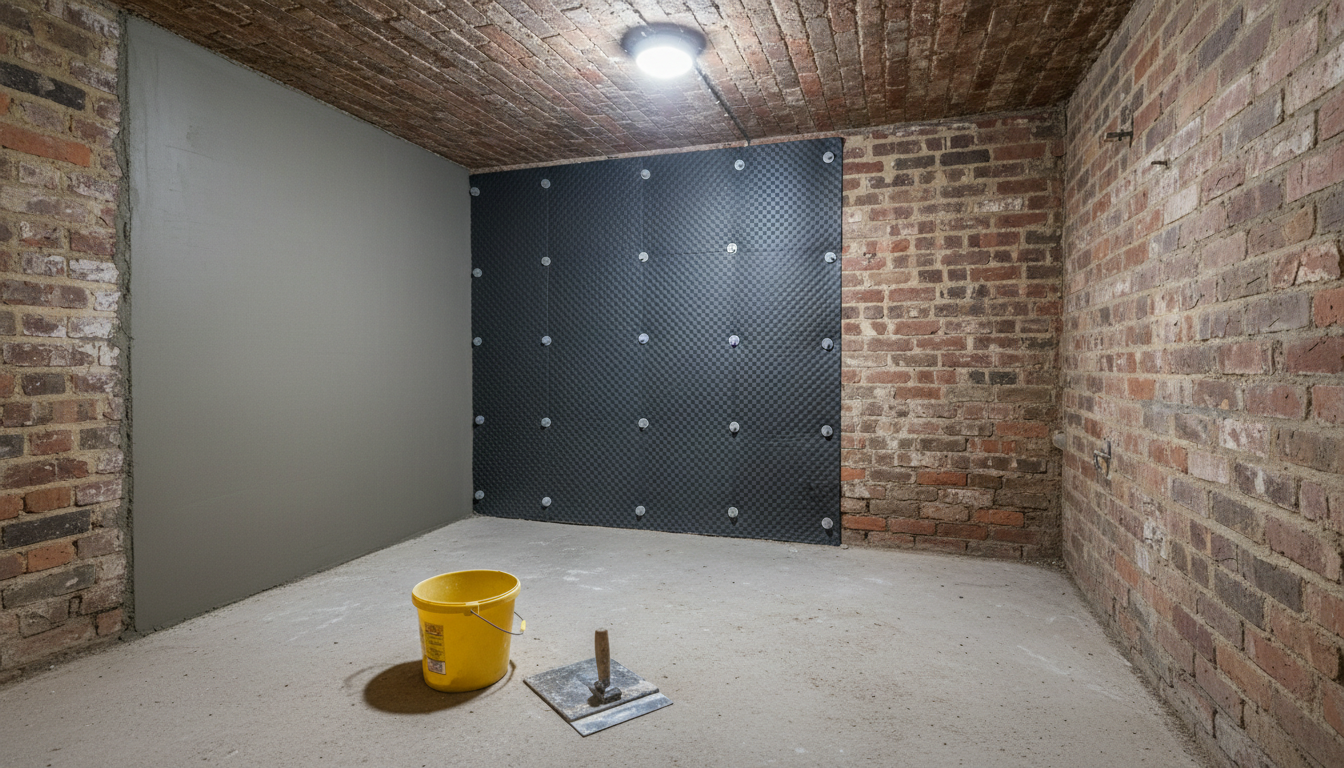
A wall with soil against its outer face, whether a cellar, a lower ground floor or a garden room dug into a bank, stays wet on that side all year. On ground where the water table sits close to the surface, that pressure is constant. Keeping the room dry means waterproofing from within: a cementitious tanking coat bonded to the bare masonry, or a dimpled membrane fixed to the wall with a drainage channel at its foot so any water seeping through is carried away. The finished surface is then plastered or boarded, and the space becomes usable living room.
Mould that comes from inside
Not every damp patch has come through a wall. Spots of black mould in the corners of bedrooms, around window frames and over the shower are almost always moisture from daily life condensing on cold surfaces. Small flats and closed-up winter houses suffer most. Extractor fans that actually run, trickle vents left open and a low, even heat do more than any treatment, and insulating a cold outside wall stops it being the place where water settles. We clean off and treat the mould, add or upgrade ventilation where needed and replaster any damaged areas.
For our full approach, see damp proofing and mould prevention, or our other services in Shoreham-by-Sea. Call 07824 165672 for free, no-obligation advice.